


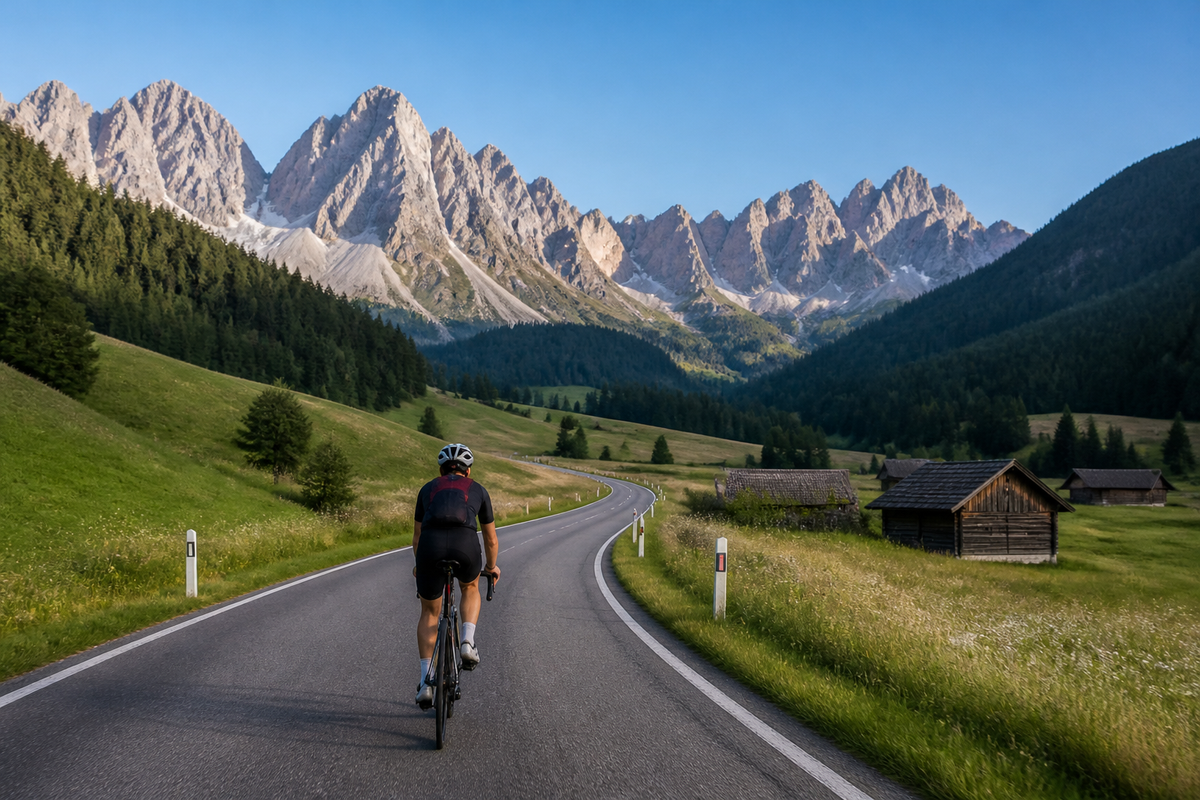
Scenic Riding
A scenic ride is not only about where you go. It is about when you go, which direction you ride, and whether you can capture the view without stopping for it.
Some rides are memorable because of the effort. Others are memorable because of the view. Scenic riding is a different discipline: the goal is not speed or distance but the quality of what you see, and that depends far more on timing than on route choice.
The good news is that a scenic ride is usually also a quiet, low-traffic ride, because the roads worth looking at are rarely the roads worth driving.
What actually makes a ride scenic
It is worth separating the components, because they can be planned independently.
- Elevation and openness: a high point with a long view is the most reliable scenic ingredient
- Water: coastlines, rivers, and lakes produce light and movement that flat inland roads cannot
- Change along the way: the transition from town to field to forest is more interesting than any single continuous landscape
- Scale: wide views read better than busy detail, both to the eye and on camera
A route with one genuinely open view is more scenic than a route with ten mediocre ones.
Plan the light before the route
On a scenic ride the light matters more than the road. The same valley can look dull at noon and remarkable two hours later.
| Time | Light quality | Best for |
|---|---|---|
| First hour after sunrise | Long shadows, soft contrast, mist | Atmosphere and depth |
| Mid-morning | Even, bright, consistent | Reliable wide views |
| Midday | Harsh, flat, high contrast | Avoid open landscapes |
| Last hour before sunset | Warm, directional, low | Colour and silhouette |
| Overcast | Soft, even, no shadows | Forest and detail |
If you can only choose one, choose the hour after sunrise. Air is clearest, traffic is quietest, and the shadows give a flat landscape a sense of depth it lacks at noon.
Planning note:: a view that faces east is best in the afternoon, and a view that faces west is best in the morning, because you want the light falling across the scene rather than behind it or straight into your eyes.
Choose direction deliberately
On a route with one standout view, ride towards it rather than away from it. This sounds obvious, but loop routes are usually planned for distance rather than for the moment when the view opens up.
Check where the key viewpoint sits and which direction the road approaches from. On a good route, the best view arrives when you are still fresh, not at kilometre ninety.
Capturing the view without stopping
Most scenic rides fail to produce anything worth keeping, for an obvious reason: stopping to take a photograph interrupts the ride. By the fifth stop, most riders stop bothering.
This is the practical case for camera glasses. Recording from the rider's own line of sight means the view you would have looked at anyway is the view that is captured, at the moment it appears rather than after you have pulled over and found a safe spot.

A few practical points make a large difference:
- Wide is better than tight. A wide field of view keeps the scale of a landscape; a narrow one reduces a valley to a corridor.
- Stabilisation matters more than resolution. Scenic roads are often descents, and a shaky wide shot is harder to watch than a softer stable one.
- Record the approach as well as the view. The road leading into a viewpoint gives the footage context.
- Keep clips short. Twenty to forty seconds is usually enough; a five-minute unbroken landscape is dull regardless of how good the view was.

Match the ride to the conditions
Scenic riding rewards flexibility. If the weather turns, do not force the planned route.
- Clear and dry: take the high route with the long view
- Overcast: favour forest, rivers, and detail rather than wide vistas
- Windy: choose sheltered valleys over exposed ridges
- Wet: consider postponing; wet roads record poorly and the view is closed in
Keep the ride a ride
The failure mode of scenic riding is treating it as a photography assignment. If you are stopping constantly to frame shots, you are not really riding, and the day is usually less enjoyable for it.
A better approach: pick two or three moments, plan roughly where they will occur, and let the camera handle them in the background. On a longer day, extended battery support means you are not forced to choose between recording the morning and recording the afternoon — Rover records up to about one hour of continuous video from the glasses, extended to roughly five hours of recording with its own power bank, subject to settings and conditions.
For route selection and how to judge roads, see road cycling routes. The 120-degree POV piece explains why a wider view suits landscapes, and EIS stabilisation covers the motion side.
If you want the capture to sit in the eyewear rather than on the bike, BleeqUp Rover pairs ZEISS lens options with a camera at eye level.
FAQ
What is the best time of day for a scenic bike ride?
The hour after sunrise is usually best: clear air, quiet roads, long shadows, and soft contrast. The hour before sunset is the next best, with warmer colour but less clarity and more traffic.
How do I find scenic bike rides near me?
Look for elevation change, water, and roads that connect two different landscapes. Heatmap and route-planning data help confirm a road is rideable, while satellite imagery shows whether it is open or enclosed.
Should I stop to take photos on a scenic ride?
Usually not more than two or three times. Constant stopping breaks the rhythm of the ride. Recording hands-free from your natural line of sight captures the view as it appears, without interrupting the ride.
Why does my footage not capture how a view felt?
Two common reasons: the field of view is too narrow, which compresses a landscape into a corridor, and there is too much camera movement. A wide angle plus stabilisation preserves both the scale and the watchability.
Is a scenic ride better on a road bike or a gravel bike?
It depends on the roads, not the scenery. A gravel bike opens up quieter tracks and often better viewpoints, while a road bike is faster on the smooth valley roads that make up many classic scenic routes.


