


Climbing
A mountain pass is decided long before the gradient starts. Gearing, pacing and what you carry matter more than fitness on the day, and the descent is a separate problem with its own risks.
Climbing is the part of cycling where preparation shows most clearly, because the variables are few and unforgiving. A climb does not care how strong you felt on the flat. It cares about your gearing, your pacing, and whether you brought enough to eat.
This is about riding passes — not racing up them. The differences between a ten-minute hill and a two-hour pass are not just scale, they are a change in kind.
What a gradient number does not tell you
A route profile reduces a climb to a line, and the line hides the thing that decides how hard it feels: how the gradient varies.
A pass averaged at 6% can be a steady grind or a series of ramps at 12% separated by flat. The average is identical. The experience is not, and neither is the gearing you need. A rider who is comfortable at 6% will be walking a 12% ramp if the bike is set up for the average.
So the first thing to look at is not the average but the distribution — where the steep sections sit, how long they run, and whether you can recover between them.
What else the profile will not tell you:
- Surface. A pass can be perfect asphalt, chip seal, or gravel over the last three kilometres. Chip seal costs you a gear or two in real terms.
- Exposure. A climb in full sun on a still day is a different climb from the same gradient in a wind corridor. Sea cliffs and valley funnels produce headwinds that are not in the profile.
- Temperature change. Climbing generates heat; descending at 50 km/h in wet kit does not. The summit can be ten degrees colder than the valley and much colder once you stop.
- What is at the top. A summit with water, a cafe and shelter is a different proposition from a summit with a sign.
Gearing: choose for the worst section, not the average
The rule is simple and almost universally ignored: pick the smallest gear you will need on the steepest sustained section, not the one you need on the average.
Modern drivetrains make this easier than it used to be. A compact crankset with a wide cassette gives you a bottom gear that would have been a mountain bike ratio twenty years ago, at the cost of a slightly larger jump between ratios. That trade is almost always worth it on an unfamiliar pass, because the failure mode of being under-geared is not "slower" — it is grinding at 40 rpm, which costs you the rest of the day.
If you ride an unfamiliar area regularly, the practical answer is to err one step lower than your home terrain suggests. You will rarely regret a gear you did not need.
Pacing that survives the top
The mistake that ruins climbs is going out too hard in the first ten minutes, when it feels easy.
Start below what feels sustainable. The first five minutes of a long climb should feel almost too easy. Riders who start at perceived effort arrive at the steep section already in debt, and climbs do not offer refinancing.
Use the steep sections to limit, not to attack. On a ramp, drop to your easiest gear early, stay seated, and keep cadence above the point where it becomes a strength exercise. Standing is a tool for short pitches and for relieving pressure, not a default.
Eat before you need to. At climbing pace, digestion is slower. Waiting until you feel empty on a pass is too late; the deficit arrives with the steep bit.
Descend within your sight line. The descent is where most pass incidents happen. Braking distances at speed are far longer than they feel, and the road you could not see beyond the corner is the road you have to stop in.

Recording a climb without stopping
Filming a pass creates a specific problem: the most interesting parts are the bottom, the steep section and the summit, and those are the moments you least want to stop and handle a device.
Three things make it workable:
A physical control away from the glasses. A handlebar or wrist mounted Bluetooth controller means start and stop happen with a thumb, gloves on, without changing your line. On a ramp this is the difference between filming it and not.
A mode that suits a long climb. There is a real constraint here that reviews tend to skip: on BleeqUp Ranger, 1080p30 records with no clip length limit, while 1080p60 and 3K60 are capped at one minute per clip and 3K30 lets you choose 1, 3 or 5. For a climb you intend to capture continuously, that decides your mode before you start.
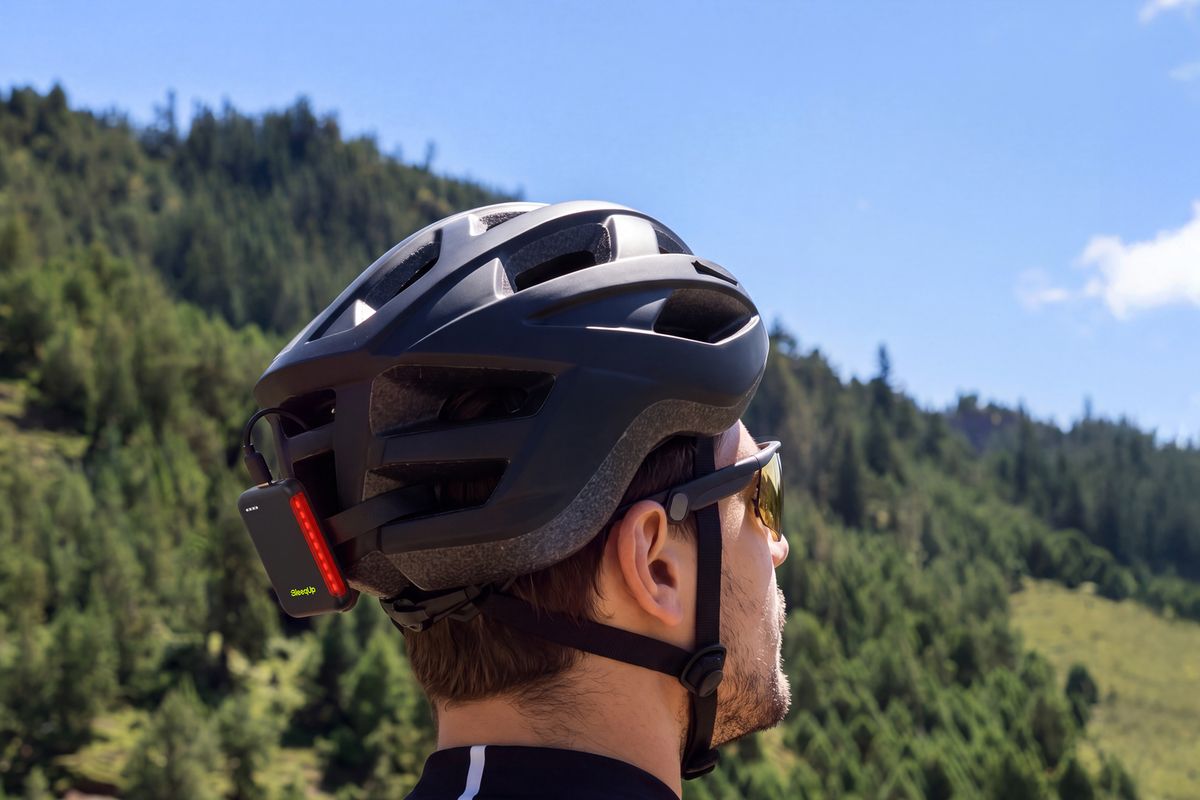
Battery planned around the whole ride, not the climb. Recording draws on the same cell as audio. With the internal battery, expect roughly an hour of video; adding the Power Plus battery pack extends that to about five hours of recording, which is the version that survives a full day in the mountains. The arithmetic is in Power Plus and longer rides.
Recording the descent is a separate decision. At speed, with both hands committed, the sensible approach is to start recording before the descent begins and leave it running. The camera being on your face rather than on the bars means the frame follows your line automatically — which is also why the footage is watchable afterwards.

Reading a pass before you ride it
A short checklist, in the order that matters:
1. Gradient distribution, not average. Find the steep ramps and how long they run. 2. Surface over the last third. That is where a good day turns into a bad one. 3. Descent quality. Surface, hairpins, and whether there is a barrier on the outside. 4. Water and shelter at the top. And whether anything is open, which depends on the season. 5. Weather at altitude. Summit conditions are routinely worse than valley conditions, and the difference is not captured by a forecast for the town below.
The broader question of finding and validating routes is covered in road cycling routes, and the planning side — including where to place capture points — in planning a bike route you will actually record.
FAQ
How do I pace a long climb?
Start below what feels sustainable, hold a cadence you can maintain seated, and treat the steep sections as places to limit effort rather than to attack. Eat before you feel empty, because digestion slows at climbing pace and the deficit arrives late.
What gearing do I need for a mountain pass?
Choose for the steepest sustained section rather than the average gradient. A compact crankset with a wide-range cassette is the usual answer, and erring one step lower than your home terrain needs is rarely regretted.
Why is the descent more dangerous than the climb?
Speed multiplies braking distance, sight lines are shorter than the speed implies, and surface problems arrive faster than you can react. Most incidents on passes happen on the way down, not the way up.
Can I record a whole climb on camera glasses?
On BleeqUp Ranger, 1080p30 has no clip length limit, so a continuous recording is possible; the 60fps modes are capped at one minute per clip and 3K30 lets you choose 1, 3 or 5. Total length is then limited by battery — about an hour internally, around five hours with Power Plus.
What is the hardest part of a mountain pass?
Usually not the gradient. Surface quality, exposure to wind, and the temperature drop between valley and summit make more difference than the number on the profile.


