


Baseball
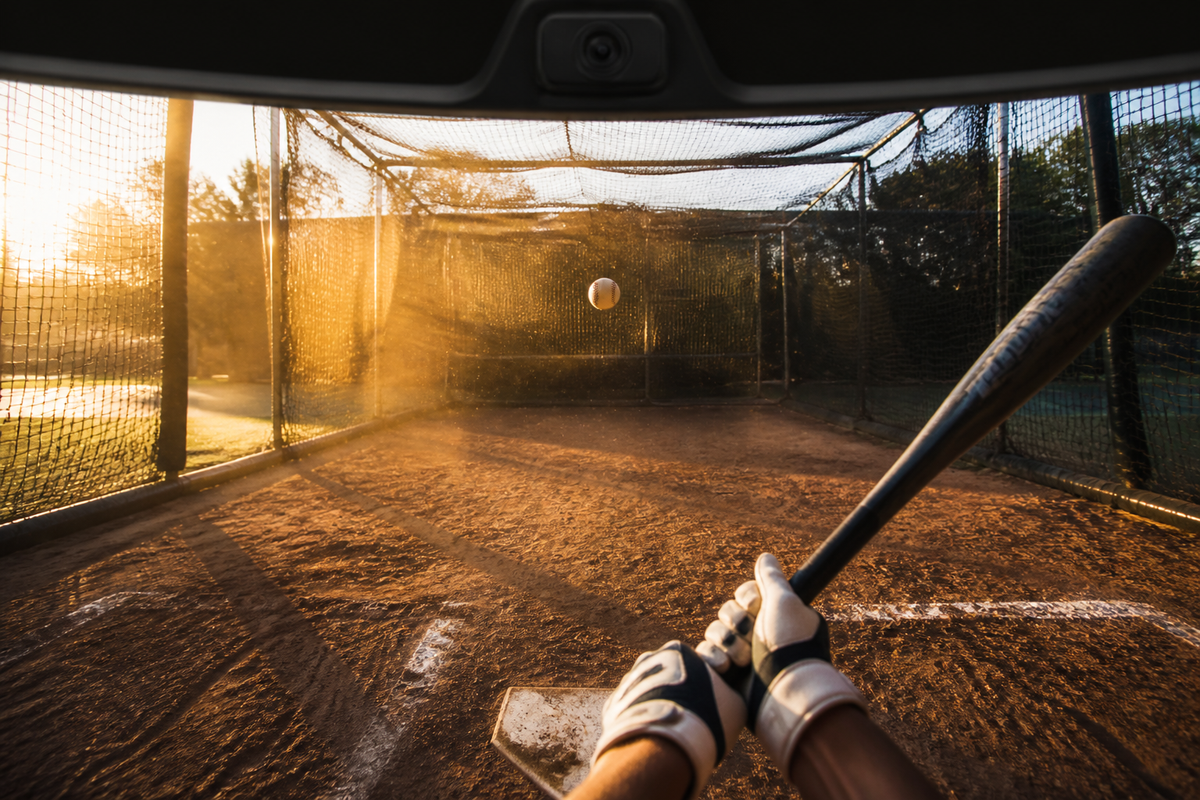
Baseball is the sport where the moment worth keeping lasts about 150 milliseconds and arrives without warning — which is why the only camera position that never costs you a rep is the one already on your face.
Watch a batter between pitches and the problem solves itself. Gloves are on, both hands are on the handle, weight is shifting, eyes are on the pitcher. There is no window in that sequence where a hand comes free long enough to press a button without also resetting the stance.
That is not a preference. It is the shape of the sport, and it is why the default amateur setup — a phone on a tripod behind the cage, or a fence-mounted camera — keeps producing footage that is technically a record and practically unusable.
Eye-level recording does not make better pictures of baseball. It makes a different picture: the one the player is already looking at.
Three viewpoints, one piece of hardware
Most baseball recording advice collapses three completely different jobs into one. They are not the same job, and a camera that suits one will frustrate you on the other two.
The hitter's view is the only one that answers the question hitters actually ask after a bad round: *when did I first pick up spin?* That question cannot be answered from behind the cage, because the camera is standing on the wrong side of the plate. From the eyes, the ball leaves the hand at the same apparent size you saw it at.
The coach's view wants mechanics — feet, hips, hands as separate components. Eye-level footage is bad at this. It flattens the body, because the head rotates with the torso and the frame moves with every swing. A coach who needs to break down a swing still wants a side-on phone on a low tripod.
The umpire's view is the one nobody writes about, and it is the most literal argument for wearing the camera. An umpire is the only person on the field whose entire job is a fixed position with both hands free and a view that no other camera can reproduce — ball, plate, catcher's glove and the batter's front foot in one frame, for three hours.

What eye-level footage genuinely shows a hitter
Two things, and it is worth being precise about them because they are easy to oversell.
Pitch recognition. From the eyes you see the release, the approach and the break as one continuous event, at the size the hitter saw it. Reviewed afterwards, the useful question is not "did I swing well" but "did I pick up the spin early or late". You can answer that from this angle and you cannot from a camera behind the net.
Swing path relative to the ball. Because the head follows the torso, the bat enters and leaves the frame around the moment of contact. It is an imperfect proxy for bat path, but it does show whether the barrel was still travelling when the ball arrived.
What it does not show is the thing most coaches want first: the lower half. If you only ever film from the eyes, you will over-weight one part of the picture and under-weight the part that usually explains the miss.
Why the hands problem is worse in the cage than in a game
Batting practice is the highest-value recording session of the week and the least camera-friendly. A round of swings is 12 to 20 pitches, then a walk-back, then another round. Nobody is going to pick up a phone between rounds, and nobody is going to leave a tripod in the middle of a cage with three hitters rotating through.
Recording in rounds rather than continuously is the routine that survives contact with a real session: on at the start of the round, off at the end, footage pulled the same evening while you still remember which round was which.
That rhythm also solves the battery question before it becomes one. Rover records for about an hour continuously on its own 260mAh battery, and a two-hour practice is longer than that. Rounds of 60 to 90 seconds turn a one-hour budget into a session-long one.

The settings that matter, and the one trap
Rover's clip limits are mode-dependent, and they are the single easiest thing to get wrong on a field:
| Mode | Per-clip limit |
|---|---|
| 1080p30 | no time limit |
| 3K30 | 1, 3 or 5 minutes per clip (selectable) |
| 1080p60 | 1 minute (fixed) |
| 3K60 | 1 minute (fixed) |
That table is worth reading twice, because the common summary — "everything except 1080p30 is capped at a minute" — is wrong. 3K30 lets you choose, and that choice is the difference between a whole round in one file and nineteen separate one-minute files.
The trap is deciding this at the plate with gloves on. Set the mode in the car, before the first round, and leave it alone.
Storage is less of a constraint than people expect: 32GB holds roughly four and a half to five and a half hours of 1080p30, and Rover is also sold with 64GB. Loop recording overwrites the oldest footage as it fills and locks highlight clips automatically — handy for a season of practice, dangerous if you never pull the file you actually wanted.
Late-afternoon light is the honest weak point
Most amateur practices in spring and autumn run into a low sun, and a small sensor in a 53g frame is not going to beat physics. High-contrast backlight is exactly where any wearable in this class struggles, and it is the second most common reason footage gets deleted.
The 120° field of view helps by keeping more of the scene in frame, so the exposure has more to work with, but it does not create light. If the sun is directly behind the pitcher, expect a silhouette.
Two smaller ones worth knowing before you rely on this:
- Helmet fit. Rover fits under a standard batting helmet, but the ear flap can press on the temple arm. Test the combination in a cage, not in a game — the pressure point shows up after about ten swings.
- Heat and duration. An hour of recording in direct sun is the practical ceiling for any battery this size, and the frame gets warm. Short bursts are the natural answer.

Consent is part of the setup, not an afterthought
Recording youth baseball is governed by league rules and by other families' consent, not only by your own. Many youth organisations require written permission from both teams, and some prohibit recording outright. Ask the coach or the league before the first session, and expect some answers to be no.
The technical capability is not the permission. That distinction matters more in baseball than in a solo sport, because a batting cage almost always has someone else's child in frame.
What to compare before you buy anything else
If you are choosing between this and a mounted action camera, the honest comparison is not image quality — a dedicated action camera wins that on a tripod it can sit on. It is *what survives a session*. An action camera needs a mount point, a mounting decision, and a spare hand at the moment the interesting thing happens. A camera pair of glasses needs neither.
For the wider field-level view of where that trade lands across sports, see camera glasses for outdoor sports, and for the head-to-head category argument, camera glasses vs action cameras.
Rover itself — including the 3K60 HDR modes, the tiltable module and the two storage options — is on the BleeqUp Rover product page.
FAQ
Do camera glasses fit under a batting helmet?
They do, but the fit is tight. The helmet's ear flap is the pressure point, and the arm of the glasses sits under it. Wear the combination for a full round of swings before you commit to it in a game; the discomfort appears after about ten swings, not on the first swing.
Can I record a game, or only practice?
That is a league and consent question, not a hardware one. Practice on a field you have permission to film is the safe default. Games usually require permission from the league and, at youth level, from the other team's families.
Is eye-level footage good enough to send to a college coach?
As a supplement, yes. Coaches generally want a side-on view for mechanics and eye-level footage for pitch recognition and decision-making. Sending only the eye-level view over-weights one half of the picture.
How long can it record before the battery runs out?
About one hour of continuous recording on the internal battery, with roughly eight hours of audio playback and around 40 hours of deep standby in between. The practical pattern for a practice is short bursts — a round recorded, a walk-back off — which stretches that hour across a whole session.
Does the camera's position on the brow matter?
A little. Mounted on the brow, the module sits slightly above the sight line, so the frame includes a bit more of the pitcher's release and slightly less of the bat through the zone. That is usually the right trade for pitch recognition and the wrong one if you want to study bat path in isolation.


